Articles · AI security and privacy
The Decryption Gap
Frontier models from Anthropic, OpenAI and Google still read your data in plaintext while they work on it. Here is how far encrypted and confidential AI has come by late 2026, what the big platforms actually ship, and how an enterprise should choose.
 Coral Petal AI ResearchInsights No. 001


Contents
The brief in one minute
The gap. Every mainstream LLM service decrypts your prompt on the provider's servers to run the model. Contracts such as zero data retention limit what happens afterward. They do not stop the provider's systems from seeing the data.
The practical fix. Hardware enclaves. Apple, Meta and Google run consumer AI inside attested confidential computing, and Apple now does it on Google Cloud. OpenAI has previewed the same idea for its API, and Anthropic has published a design and taken on a confidential-computing team.
The cost. Enclaves are cheap when tuned. Studies on NVIDIA H100 and Blackwell GPUs measure 1 to 7 percent lost throughput, though a default stack can lose 13 to 27 percent.
The frontier. Fully homomorphic encryption, where the server never decrypts at all, passed a milestone in 2026: Llama 3 with 8 billion parameters now generates a token in 18 seconds under encryption. That suits overnight batch work. It is far too slow for chat.
The playbook. Climb a ladder: minimize what you send, isolate what you can, demand attestation where it exists, and reserve cryptography for narrow, high-value jobs. India's DPDP Rules already name encryption, masking and tokens as baseline safeguards.
Encryption has a blind spot
Enterprise data is usually encrypted twice, at rest on disk and in transit across the network. Neither layer covers the moment the data is used. To answer a prompt, a language model multiplies large arrays of numbers that represent your words. Those numbers sit as plaintext in an accelerator's memory, together with any documents retrieved for context and the answer the model writes.
If you host an open-weight model yourself, that accelerator is yours. Frontier models such as Claude, GPT and Gemini work differently. Their weights never leave the provider, so your data travels to them and is decrypted on their hardware. That is the decryption gap. The J.P. Morgan team behind EncryptedLLM describes the trade-off plainly: outsourcing inference "risks leaking the clients' LLM queries to the cloud provider."1
The exposure has measurable costs. IBM's 2025 breach study found that 13 percent of organizations reported breaches of AI models or applications, and 97 percent of those lacked proper AI access controls. Organizations with high levels of shadow AI paid about $670,000 more per breach than those with little or none.2 Models are also imperfect custodians of what they see. In the CONFAIDE benchmark, GPT-4 and ChatGPT revealed private information in contexts where people would not 39 percent and 57 percent of the time.3
Five ways to narrow the gap
No single control closes the gap. The options form a ladder. Each rung removes a party you have to trust and adds cost, so the right height depends on the data.
Figure 1
The trust ladder
Each rung removes a party you must trust. Cost and latency rise as you climb.
Contract
Written promises: no training on your data, zero data retention, regional processing.
- You still trust
- The provider's systems and people
- Cost today
- None
- Examples
- Zero data retention at Anthropic and OpenAI
Minimize
Redact, mask or tokenize identifiers before a prompt leaves your network.
- You still trust
- The provider, with less to see
- Cost today
- Low; some loss of context
- Examples
- DPDP Rule 6 names masking and virtual tokens
Isolate
Run open-weight models in your own perimeter or an air-gapped cloud.
- You still trust
- Your own operations
- Cost today
- Hardware and staff; a capability gap to frontier models
- Examples
- gpt-oss, Gemini on Google Distributed Cloud
Attest
Run inference in hardware enclaves that prove which code runs before any data arrives.
- You still trust
- Chip makers and the attestation chain
- Cost today
- About 1 to 7 percent when tuned
- Examples
- Apple PCC, Meta Private Processing, Google Private AI Compute
Encrypt in use
The server computes on ciphertext and never sees the data.
- You still trust
- The mathematics; for MPC, that servers do not collude
- Cost today
- Seconds to minutes per token
- Examples
- EncryptedLLM, Sylph, PUMA
The first two rungs are available today from every major provider. Under Anthropic's zero data retention arrangement, the company "does not store customer prompts or responses at rest after the API response is returned."4 OpenAI makes the same promise to eligible API customers, and since September 2026 it has been rolling out Private Safety Processing, which runs abuse detection without staff access: "OpenAI personnel do not receive access to the customer content even when it is flagged."5 Both are policies about what happens after inference. The plaintext still exists while the model runs.
Minimization is the cheapest rung and the one most teams skip. A gateway that swaps names, account numbers and other identifiers for tokens before a prompt leaves your network, then swaps them back in the answer, removes most of what an attacker or an insider could misuse. India's Digital Personal Data Protection Rules, 2025, list "encryption, obfuscation, masking or the use of virtual tokens mapped to that personal data" among the minimum safeguards a data fiduciary must apply.6
Isolation trades capability for control. OpenAI's open-weight gpt-oss-120b runs on a single 80 GB GPU under an Apache 2.0 license and comes close to o4-mini on core reasoning benchmarks.7 Google sells Gemini itself on Google Distributed Cloud, including fully air-gapped installations, generally available since August 2025.8 Neither option puts Claude or the newest GPT models inside your own walls.
Confidential inference is how the big platforms ship private AI
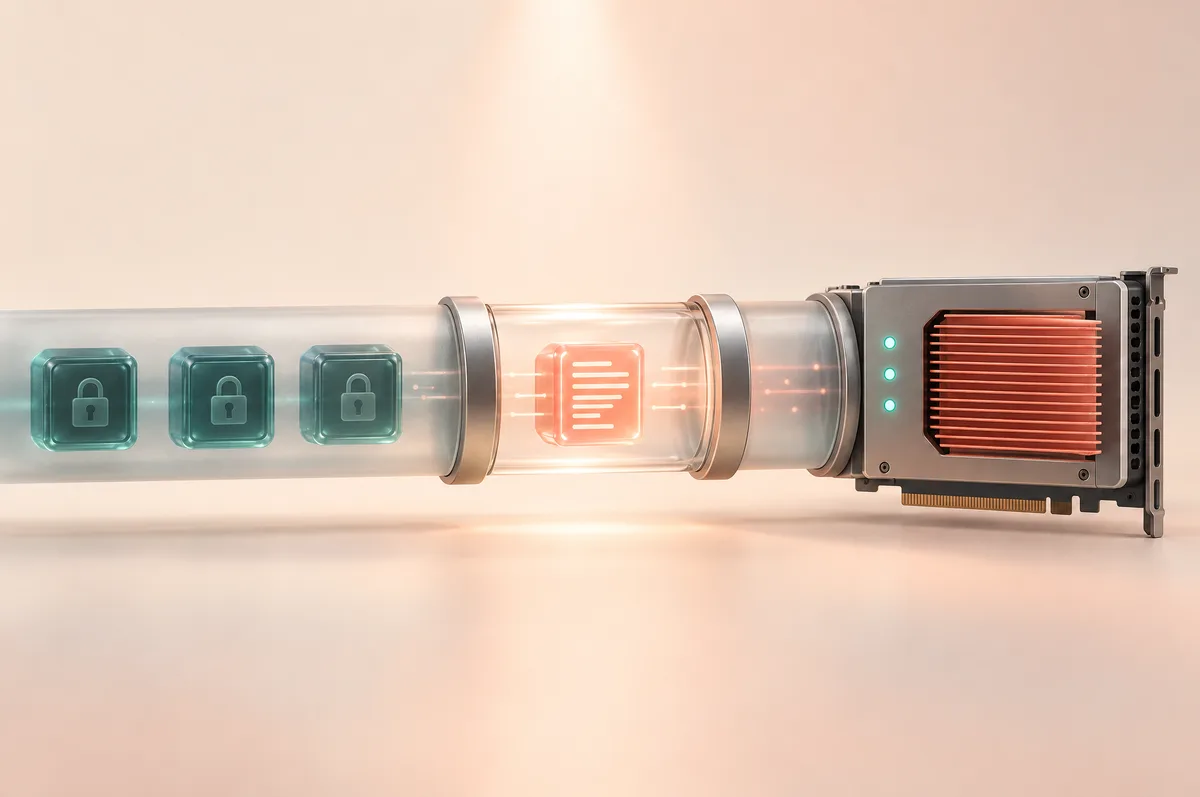
Confidential computing closes the gap with hardware. CPUs with Intel TDX or AMD SEV-SNP encrypt a virtual machine's memory, so the host operating system, the hypervisor and the cloud's administrators cannot read it. Since the H100, NVIDIA GPUs add a confidential mode that encrypts traffic between that virtual machine and the GPU. Remote attestation completes the design. Before a client sends anything, the enclave proves which code it runs, and the client releases its data only if that measurement matches a published one.
Figure 2
How confidential inference keeps the operator out
The client checks the enclave's code before it sends anything. Plaintext exists only inside the attested boundary.
The consumer platforms adopted this first because their privacy promises are public. Apple's Private Cloud Compute, launched in June 2024, set the template: stateless processing, no privileged access for staff, and "verifiable transparency," which lets outside researchers inspect the software the servers run.11 In June 2026 Apple extended it to Google Cloud, on Intel TDX and NVIDIA confidential GPUs.14 Meta has run AI features for WhatsApp in confidential virtual machines under Private Processing since April 2025,12 and Google launched Private AI Compute for Gemini features in November 2025, built on its TPUs and Titanium Intelligence Enclaves.15 Microsoft offers a preview of confidential inferencing in Azure AI on H100 confidential virtual machines with Oblivious HTTP, starting with the Whisper speech model.13
The frontier labs are a step behind for enterprise customers. Anthropic published its design with Pattern Labs in June 2025. A small trusted loader runs in an isolated virtual machine, presents itself as a "virtual accelerator" and accepts only programs signed by Anthropic's build system, and keys are released only to servers that prove their state.10 Anthropic called the paper "a sketch of our research to start a conversation." In October 2026 the team of confidential AI startup Opaque Systems joined Anthropic in what reports describe as a license-and-hire deal. No product has been announced.16 OpenAI grouped its data controls under the name Private Intelligence at DevDay in September 2026 and previewed Private Inference, which coverage describes as confidential computing for model inference. Technical details had not been published at the time of writing.17
Sensitive data should remain encrypted except at the point where it's processed.
Performance is no longer the obstacle. On H100 GPUs, overhead stayed below 7 percent for most typical LLM queries and approached zero for larger models and longer sequences.18 On Blackwell, a tuned stack lost 1 to 3 percent of throughput,19 and NVIDIA reports up to 98 percent of non-confidential performance on HGX B300.20 Configuration matters. With default settings, Phala Network's engineers measured a 13 to 27 percent throughput loss and a 34-fold slowdown in model loading, traced to the serialized encrypted bridge between the virtual machine and the GPU.21
Figure 3
Hardware enclaves cost little when the stack is tuned
Throughput lost when LLM inference runs in GPU confidential-computing mode, by study. Bars show the reported range; the green band marks tuned results.
Throughput lost versus the same hardware without confidential computing
Show the data
| # | Setup | Hardware | Throughput lost | Source |
|---|---|---|---|---|
| 1 | Tuned stack | NVIDIA B200, Intel TDX | 1–3% | Asad and Grunseid, 202619 |
| 2 | Vendor benchmarks | NVIDIA HGX B200 and B300 | ≈2–5% | NVIDIA, 202620 |
| 3 | Typical LLM queries | NVIDIA H100 and H200 | under 7% | Zhu et al., 202418 |
| 4 | Default serving stack | NVIDIA Blackwell, Intel TDX | 13–27% | Yin and Wang, 202621 |
Enclaves move trust. They do not remove it. In October 2025 researchers disclosed TEE.fail, a memory-bus interposer built for under $1,000 that extracted attestation keys from Intel's and AMD's confidential computing and undermined NVIDIA's GPU attestation. Intel and AMD consider physical attacks outside their threat models.22 Audits keep finding deployment gaps. NCC Group found a timing side channel in the relay that hides users' IP addresses in Google's system, which Google rated low risk,23 and Trail of Bits' 2026 audit of WhatsApp's private inference found implementation and deployment gaps, including replayable attestation reports, that Meta has since fixed.24 Verify attestation in your own code instead of taking the label on trust.
The cryptographic frontier: computing on data no one can read
Cryptography takes the hardware out of the trust equation. Fully homomorphic encryption (FHE) lets a server compute directly on ciphertext. The client encrypts its prompt, the server runs the model on the encrypted numbers, and only the client's key can read the result. Craig Gentry proved it possible in 2009,25 and the CKKS scheme of 2017 made it practical for the approximate arithmetic neural networks use.26 Secure multiparty computation (MPC) takes a different route. It splits the data into shares across several servers that must not collude.
The hard part is the nonlinear math inside a transformer. FHE natively adds and multiplies, so softmax, GeLU and layer normalization must be replaced with polynomial approximations, and the ciphertext must be refreshed periodically by an expensive step called bootstrapping. EncryptedLLM, presented at ICML 2025 by J.P. Morgan researchers, moved that work onto GPUs. An encrypted GPT-2 forward pass fell from roughly four hours on a CPU to about 69 seconds per token on one NVIDIA A100, at 128-bit security and with benchmark accuracy almost unchanged.1 The authors are candid that "real-time chatbots under FHE remains out of reach," while summarization, drafting and fine-tuning on private data are now practical.
Then the curve bent again. In January 2026, CryptoLab and Seoul National University reported Sylph, which runs Llama-3-8B, a model about 65 times larger than GPT-2 small, on 128 encrypted input tokens: 20 seconds to read the input and 18 seconds per generated token on eight NVIDIA RTX PRO 6000 GPUs. The previous best system needed 295 seconds on eight H100s for the same reading step. Sylph also handles a 4,096-token prompt whose last 128 tokens are private, at 22 seconds per token.27 For comparison, PUMA, the best-known MPC result, took about five minutes per token for LLaMA-7B in 2023.28
Figure 4
Encrypted inference is getting faster
Seconds to generate one token while the server never sees the input, as each study reports it. Log scale. Coral marks the 2026 results.
Seconds per generated token, log scale
Show the data
| # | System | Model | Hardware | Seconds per token | Source |
|---|---|---|---|---|---|
| 1 | FHE, OpenFHE on CPU | GPT-2 small (124M) | Intel Xeon | ≈15,000 | de Castro et al., 20251 |
| 2 | MPC, three parties (PUMA) | LLaMA-7B | Three servers | ≈300 | Dong et al., 202328 |
| 3 | FHE on GPU (EncryptedLLM) | GPT-2 small (124M) | 1× NVIDIA A100 | ≈69 | de Castro et al., 20251 |
| 4 | FHE on GPU (Sylph) | Llama-3-8B | 1× NVIDIA RTX PRO 6000 | 31 | Park et al., 202627 |
| 5 | FHE on GPU (Sylph) | Llama-3-8B | 8× NVIDIA RTX PRO 6000 | 18 | Park et al., 202627 |
Three limits remain. Speed rules out chat and agent loops. The model owner has to run the encrypted model, so FHE helps only when a provider adopts it, and none of the frontier labs has announced FHE inference. The guarantees are also narrow: in EncryptedLLM's threat model the server learns nothing about the input, but nothing guarantees that the answer it returns is correct.1
Where the major providers stand
The table summarizes what each provider offers for sensitive data today and how far each has gone toward confidential or encrypted inference. A "reported" tag marks items that rest on press coverage rather than the company's own publication.
Table 1
Where the major AI providers stand, November 2026
| # | Provider | Confidential inference | Shipping today for sensitive data | Confidential or encrypted inference |
|---|---|---|---|---|
| 1 | Anthropic Claude | Research | Zero data retention by arrangement for eligible API features, including Claude on AWS and Google Cloud4 | Design paper with Pattern Labs, June 2025;10 Opaque Systems team joins, October 2026 reported16; no product announced |
| 2 | OpenAI GPT | Preview | Zero data retention for eligible API customers; Private Safety Processing rolling out since September 22, 2026;5 open-weight gpt-oss for self-hosting7 | Private Inference previewed at DevDay, September 2026 reported17; technical details pending |
| 3 | Google Gemini | Shipping, consumer | Gemini on Google Distributed Cloud, including air-gapped, generally available August 20258 | Private AI Compute for consumer Gemini features, November 2025;15 hosts Apple's Private Cloud Compute since June 202614 |
| 4 | Microsoft Azure AI | Preview | Azure OpenAI within the Azure boundary | Confidential inferencing preview on H100 confidential VMs with Oblivious HTTP, starting with Whisper13 |
| 5 | Apple Apple Intelligence | Shipping, consumer | On-device models first | Private Cloud Compute since June 2024;11 extended to Google Cloud on Intel TDX and NVIDIA confidential GPUs, June 202614 |
| 6 | Meta Meta AI | Shipping, consumer | AI features in WhatsApp | Private Processing since April 2025;12 audited by Trail of Bits, 2026;24 extended to Meta AI glasses, September 202629 |
Shipping, consumer in production for consumer featuresPreview announced or limitedResearch published design, no product
Figure 5
From promise to proof, 2024 to 2026
Sixteen milestones by month and type. Platform launches speed up through 2026. Coral marks cryptographic results; hover or focus a dot for details.
2024
2025
- 4Apr 2025Meta launches Private Processing for WhatsApp12
- 5Jun 2025Anthropic and Pattern Labs publish a confidential inference design10
- 6Jul 2025EncryptedLLM at ICML: encrypted GPT-2 at about a minute per token1
- 7Aug 2025OpenAI releases open-weight gpt-oss; Gemini reaches air-gapped data centers7,8
- 8Oct 2025TEE.fail extracts attestation keys with a sub-$1,000 interposer22
- 9Nov 2025Google launches Private AI Compute15
- 10Nov 2025India notifies the Digital Personal Data Protection Rules, 20256
2026
- 11Jan 2026Sylph runs Llama-3-8B under FHE at 18 seconds per token27
- 12Apr 2026Trail of Bits audits WhatsApp's private inference; fixes follow24
- 13Jun 2026Apple runs Private Cloud Compute on Google Cloud14
- 14Aug 2026Blackwell benchmark: 1 to 3 percent overhead on a tuned stack19
- 15Sep 2026OpenAI rolls out Private Safety Processing and previews Private Inference5,17
- 16Oct 2026Opaque Systems' team joins Anthropic (reported)16
Matching protection to your data
For most enterprises the decision starts with a data inventory. Classify what an AI system will touch, then apply the lowest rung that meets the risk. Spend more only where the data demands it.
Table 2
Matching protection to data
Four data classes, from least to most sensitive. The bars show sensitivity.
What to watch in 2027
- 1. Enterprise confidential inference from the frontier labs
Watch OpenAI's Private Inference preview and what Anthropic builds with the Opaque team. Look for independent keyservers and published measurements, which Anthropic has said it is exploring.10,16,17
- 2. Verification as a routine control
Expect buyers to check attestation in their own code, to use open stacks such as OpenPCC, built on Intel TDX and H100 GPUs,30 and to ask for third-party audits.
- 3. FHE pilots on real workloads
At 18 seconds per token for an 8B model, encrypted summarization and scoring fit overnight batches. The next milestone to watch is single-digit seconds per token.
- 4. Compliance clocks
India's DPDP Rules bring their main obligations into force in May 2027,6 and Gartner predicts that by 2029 more than 75 percent of operations processed in untrusted infrastructure will be secured in use by confidential computing.31
The bottom line
In one paragraph
The decryption gap is narrowing from two directions. Hardware enclaves already let platforms promise that no one, including the operator, can read data during inference, for a few percent of throughput when the stack is tuned. Cryptography removes the need to trust hardware at all, and it is now fast enough for patient, high-value work. Until the frontier labs offer attested inference to enterprises, the strongest practical posture combines minimization, isolation and contracts, each chosen for the data it protects.
About this brief. Evidence current to November 21, 2026. Values marked ≈ were read from published charts or rounded. Quotes are verbatim from the cited sources. This brief is for information only and is not legal or security advice.
References
- de Castro, L., Escudero, D., Agrawal, A., Polychroniadou, A., and Veloso, M. (2025). EncryptedLLM: Privacy-Preserving Large Language Model Inference via GPU-Accelerated Fully Homomorphic Encryption. Proceedings of the 42nd International Conference on Machine Learning, PMLR 267, 12677–12688. proceedings.mlr.press/v267/de-castro25a.html
- IBM. (2025, July 30). IBM Report: 13% of organizations reported breaches of AI models or applications, 97% of which reported lacking proper AI access controls. Cost of a Data Breach Report 2025. newsroom.ibm.com
- Mireshghallah, N., Kim, H., Zhou, X., Tsvetkov, Y., Sap, M., Shokri, R., and Choi, Y. (2024). Can LLMs Keep a Secret? Testing Privacy Implications of Language Models via Contextual Integrity Theory. ICLR 2024. openreview.net/forum?id=gmg7t8b4s0
- Anthropic. API and data retention: zero data retention (ZDR). Claude Platform documentation, accessed November 21, 2026. platform.claude.com/docs/en/manage-claude/api-and-data-retention
- OpenAI. (2026, August 19; updated September 22). Offering Zero Data Retention for frontier models. openai.com/index/offering-zero-data-retention-for-frontier-models
- Ministry of Electronics and Information Technology, Government of India. (2025, November 13). Digital Personal Data Protection Rules, 2025, G.S.R. 846(E), Rule 6(1)(a); and Press Information Bureau, "DPDP Rules, 2025 Notified," November 17, 2025. static.pib.gov.in
- OpenAI. (2025, August 5). Introducing gpt-oss. openai.com/index/introducing-gpt-oss
- Google Cloud. (2025, August). Gemini is now available anywhere: Gemini on Google Distributed Cloud. cloud.google.com/blog
- Google Research. (2025, September). VaultGemma: The world's most capable differentially private LLM. research.google/blog
- Anthropic, with Pattern Labs. (2025, June 18). Confidential Inference via Trusted Virtual Machines. anthropic.com/research/confidential-inference-trusted-vms
- Apple Security Engineering and Architecture. (2024, June 10). Private Cloud Compute: A new frontier for AI privacy in the cloud. security.apple.com/blog/private-cloud-compute
- Meta Engineering. (2025, April 29). Building Private Processing for AI tools on WhatsApp. engineering.fb.com
- Microsoft. Azure AI Confidential Inferencing: Technical Deep-Dive. Microsoft Tech Community, 2024, updated December 2025. techcommunity.microsoft.com
- Apple Security Engineering and Architecture. (2026, June 8). Expanding Private Cloud Compute. security.apple.com/blog/expanding-pcc; and Google Cloud, "Powering the next era of confidential AI," June 2026. cloud.google.com/blog
- Google. (2025, November 11). Private AI Compute: our next step in building private and helpful AI. blog.google
- Constellation Research. (2026, October). Anthropic licenses, releases Opaque in acquihire. constellationr.com; and The New Stack, Anthropic and Opaque confidential computing, October 2026. thenewstack.io
- VentureBeat. (2026, September). OpenAI's new "Private Intelligence" targets a growing enterprise concern: who can see your AI data? venturebeat.com
- Zhu, J., Yin, H., Deng, P., Almeida, A., and Zhou, S. (2024). Confidential Computing on NVIDIA Hopper GPUs: A Performance Benchmark Study. arXiv:2409.03992. arxiv.org/abs/2409.03992
- Asad, A., and Grunseid, A. (2026, August 27). Benchmarking Confidential Computing Performance on NVIDIA Blackwell GPUs. arXiv:2608.26575. arxiv.org/abs/2608.26575
- NVIDIA Technical Blog. (2026). Hardware-Rooted AI Security That Won't Slow You Down. developer.nvidia.com/blog
- Yin, H., and Wang, K. (2026, June 22). The Serialized Bridge: Understanding and Recovering LLM Serving Performance under Blackwell GPU Confidential Computing. arXiv:2606.23969. arxiv.org/abs/2606.23969
- The Hacker News. (2025, October). New TEE.Fail side-channel attack extracts secrets from Intel and AMD DDR5 secure enclaves. Research by Georgia Tech, Purdue University and Synkhronix. thehackernews.com
- The Hacker News. (2025, November). Google launches Private AI Compute, citing NCC Group's assessment. thehackernews.com
- Trail of Bits. (2026, April 7). What we learned about TEE security from auditing WhatsApp's Private Inference. blog.trailofbits.com
- Gentry, C. (2009). Fully homomorphic encryption using ideal lattices. Proceedings of the 41st ACM Symposium on Theory of Computing, 169–178. doi.org/10.1145/1536414.1536440
- Cheon, J. H., Kim, A., Kim, M., and Song, Y. (2017). Homomorphic encryption for arithmetic of approximate numbers. ASIACRYPT 2017, 409–437. doi.org/10.1007/978-3-319-70694-8_15
- Park, J., Park, S., Park, J. H., Ahn, J. H., Cheon, J. H., Hanrot, G., Kim, J. W., Park, M., and Stehlé, D. (2026). Scaling up FHE-based Privacy-Preserving ML: Higher Throughput, Longer Inputs for LLama-3-8B. arXiv:2601.18511. arxiv.org/abs/2601.18511
- Dong, Y., Lu, W.-j., Zheng, Y., Wu, H., Zhao, D., Tan, J., Huang, Z., Hong, C., Wei, T., and Cheng, W. (2023). PUMA: Secure Inference of LLaMA-7B in Five Minutes. arXiv:2307.12533. arxiv.org/abs/2307.12533
- Meta Engineering. (2026, September 23). Bringing Private Processing to Meta AI Glasses. engineering.fb.com
- Zhou, H., Zhao, S., Wang, C., and Lin, Z. (2026, June 9). OpenPCC: Open and Confidential LLM Serving on Commodity TEEs. arXiv:2606.11145. arxiv.org/abs/2606.11145
- Gartner. (2025, October 20). Gartner Identifies the Top Strategic Technology Trends for 2026. gartner.com/en/newsroom
Cite this briefCoral Petal AI Research. "The Decryption Gap." Coral Petal AI Insights, no. 001, November 21, 2026.
Coral Petal AI is an Agentic AI consultancy that helps enterprises adopt the latest advances in AI, end to end. What we do
Planning an AI rollout that touches sensitive data?
Coral Petal AI helps enterprises design agentic AI systems end to end, including how each class of data reaches a model.